



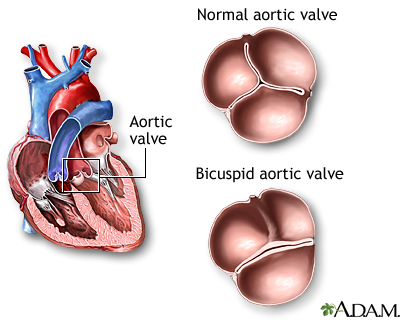
A bicuspid aortic valve (BAV) is an aortic valve that only has two leaflets, instead of three.
The aortic valve regulates blood flow from the heart into the aorta. The aorta is the major blood vessel that brings oxygen-rich blood to the body.
Causes
The aortic valve allows oxygen-rich blood to flow from the heart to the aorta. It prevents the blood from flowing back from the aorta into the heart when the pumping chamber relaxes.
BAV is present at birth (congenital). An abnormal aortic valve develops during the early weeks of pregnancy, when the baby's heart is developing. The cause of this problem is unclear, but it is the most common congenital heart defect. BAV often runs in families.
A BAV may not be completely effective at stopping blood from leaking back into the heart. This leakage is called aortic regurgitation. The aortic valve may also become stiff and not open up. This is called aortic stenosis, which causes the heart to pump harder than usual to get blood through the valve. The aorta may become enlarged with this condition.
BAV is more common among males than females.
A BAV often exists in babies with coarctation of the aorta (narrowing of the aorta). BAV is also seen in diseases in which there is a blockage to blood flow on the left side of the heart.
Symptoms
Most of the time, BAV is not diagnosed in infants or children because it causes no symptoms. However, the abnormal valve can leak or become narrow over time.
Symptoms of such complications may include:
- Baby or child tires easily
- Chest pain
- Difficulty breathing
- Rapid and irregular heartbeat (palpitations)
- Loss of consciousness (fainting)
- Pale skin (pallor)
If a baby has other congenital heart problems, they may cause symptoms that will lead to the discovery of a BAV.
Exams and Tests
During an exam, your health care provider may find signs of a BAV including:
- Enlarged heart
- Heart murmur
- Weak pulse in the wrists and ankles
Tests that may be ordered include:
- Chest x-ray, which produces an image of the heart and large arteries
- Electrocardiogram (ECG), which measures the electrical activity of the heart
- MRI, which provides a detailed image of the heart
- Echocardiogram, which is an ultrasound that views the heart structures and blood flow inside the heart
If your provider suspects complications or additional heart defects, other tests may include:
- Cardiac catheterization, a procedure in which a thin tube (catheter) is placed into the heart to see blood flow and take accurate measurements of blood pressure and oxygen levels
- MRA, an MRI that uses a dye to view the blood vessels of the heart
Treatment
Your infant or child may need surgery to repair or replace a leaky or narrowed valve, if complications are severe.
A narrowed valve can also be opened through cardiac catheterization. A fine tube (catheter) is directed to the heart and into the narrow opening of the aortic valve. A balloon attached to the end of the tube is inflated to make the opening of the valve larger.
In adults, when a bicuspid valve becomes very leaky or very narrowed, it may need to be replaced. This used to be possible only with open heart surgery but can now sometimes be done via catheters.
Sometimes the aorta may also need to be repaired if it has become too wide or is too narrow.
Medicine may be needed to relieve symptoms or prevent complications. Medicines may include:
- Medicines that lower the workload on the heart (beta-blockers, ACE inhibitors)
- Medicines that make the heart muscle pump harder (inotropic agents)
- Water pills (diuretics)
Outlook (Prognosis)
How well the person does depends on the presence and severity of complications of BAV.
The presence of other physical problems at birth also can affect how well a person does.
Most babies with this condition have no symptoms, and the problem is not diagnosed until they are adults. Some people never find out that they have this problem.
Possible Complications
Complications of BAV include:
- Heart failure
- Leakage of blood through the valve back into the heart
- Narrowing of the valve's opening
- Infection of the heart muscle or aortic valve
When to Contact a Medical Professional
Contact your child's provider if your baby:
- Has no appetite
- Has unusually pale or bluish skin
- Seems to tire easily
Prevention
BAV runs in families. If you know of this condition in your family, speak to your provider before becoming pregnant. There is no known way to prevent the condition.
Alternative Names
Bicommissural aortic valve; Valvular disease - bicuspid aortic valve; BAV
Patient Instructions
Images

References
Fraser CD, Vricella LA, Cameron DE. Aortopathies in pediatric cardiology and cardiac surgery. In: Wernovsky G, Anderson RH, Kumar K, et al, eds. Anderson's Pediatric Cardiology. 4th ed. Philadelphia, PA: Elsevier; 2020:chap 58.
Isselbacher EM, Preventza O, Black JH 3rd, et al. 2022 ACC/AHA guideline for the diagnosis and management of aortic disease: a report of the American Heart Association/American College of Cardiology Joint Committee on Clinical Practice Guidelines. Circulation. 2022:146(24):e334-e482. PMID: 36322642 pubmed.ncbi.nlm.nih.gov/36322642/.
Michelena HI, Rodríguez-Palomares JF, Corte AD. The bicuspid aortic valve and associated aortic disease. In: Otto CM, Lindman BR, eds. Valvular Heart Disease: A Companion to Braunwald's Heart Disease. 6th ed. Philadelphia, PA: Elsevier; 2027:chap 10.
Nazif TM, Leon MB, Mack MJ. Transcatheter aortic valve replacement. In: Bonow RO, Mann DL, Tomaselli GF, et al, eds. Braunwald's Heart Disease: A Textbook of Cardiovascular Medicine. 13th ed. Philadelphia, PA: Elsevier; 2026: chap 70.
Review Date 6/1/2026
Updated by: Thomas S. Metkus, MD, PhD, Associate Professor of Medicine and Surgery, Johns Hopkins University School of Medicine, Baltimore, MD. Also reviewed by David C. Dugdale, MD, Medical Director, Brenda Conaway, Editorial Director, and the A.D.A.M. Editorial team.