



A bounding pulse is a strong throbbing felt over one of the arteries in the body. It is due to a forceful heartbeat.
Causes
A bounding pulse and rapid heart rate may both occur in the following conditions or events:
- Abnormal or rapid heart rhythms
- Anemia
- Anxiety
- Long-term (chronic) kidney disease
- Fever
- Heart failure
- Heart valve problem called aortic regurgitation
- Heavy exercise
- Overactive thyroid (hyperthyroidism)
- Pregnancy, because of increased fluid and blood in the body
- Use of caffeine or other stimulants
When to Contact a Medical Professional
Contact your health care provider if the intensity or rate of your pulse increases suddenly and does not go away. This is very important when:
- You have other symptoms along with increased pulse, such as chest pain, shortness of breath, feeling faint, or loss of consciousness.
- The change in your pulse does not go away when you rest for a few minutes.
- You already have been diagnosed with a heart problem.
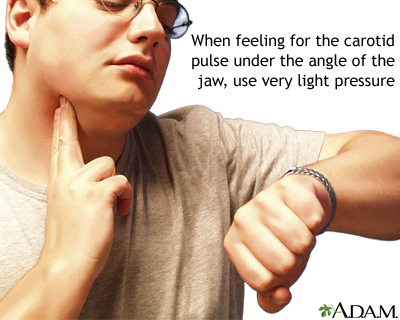
What to Expect at Your Office Visit
Your provider will do a physical exam that includes checking your temperature, pulse, breathing rate, and blood pressure. Your heart and circulation will also be checked.
Your provider will ask questions such as:
- Is this the first time you have felt a bounding pulse?
- Did it develop suddenly or gradually? Is it always present, or does it come and go?
- Does it only happen along with other symptoms, such as palpitations? What other symptoms do you have?
- Does it get better if you rest?
- Are you pregnant?
- Have you had a fever?
- Have you been very anxious or stressed?
- Do you have other heart problems, such as heart valve disease, high blood pressure, or congestive heart failure?
- Do you have kidney disease?
- Do you consume stimulants such as caffeine or cold medicine or drugs such as amphetamines or cocaine?
The following diagnostic tests may be performed:
- Blood tests (CBC or complete blood count), basic metabolic panel
- Chest x-ray
- Electrocardiogram (ECG)
- Echocardiogram
Alternative Names
Bounding pulse
Images

References
Fang JC, Metkus TS, O'Gara PT. History, physical examination, and the virtual visit. In: Bonow RO, Mann DL, Tomaselli GF, et al, eds. Braunwald's Heart Disease: A Textbook of Cardiovascular Medicine. 13th ed. Philadelphia, PA: Elsevier; 2026:chap 11.
Goldman L. Approach to the patient with possible cardiovascular disease. In: Goldman L, Cooney KA, eds. Goldman-Cecil Medicine. 27th ed. Philadelphia, PA: Elsevier; 2024:chap 39.
Japp AG, Din JN, Robson JMJ. The cardiovascular system. In: Dover AR, Innes JA, Fairhurst K, eds. Macleod's Clinical Examination. 15th ed. Philadelphia, PA: Elsevier; 2024:chap 4.
Review Date 6/4/2026
Updated by: Jacob Berman, MD, MPH, Associate Professor of Medicine, Division of General Internal Medicine, University of Washington School of Medicine, Seattle, WA. Also reviewed by David C. Dugdale, MD, Medical Director, Brenda Conaway, Editorial Director, and the A.D.A.M. Editorial team.